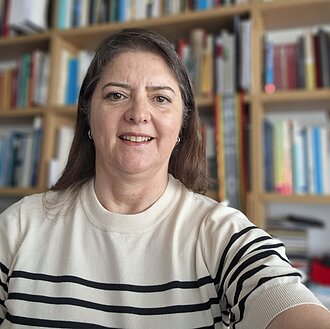
Prof. Paula Guimarães
What excites you about adult learning and education?
" I like to learn more about adult learning and education policies, practices and research in order to be more critical in what concerns discourses in adult learning and education policies at the international and national levels, as well as in what happens in different education and learning contexts (formal, non-formal and informal) and to be critically aware and informed about the developments in research, in the different streams that we can find."
Why did you choose to do research in the field of adult learning and education?
"To do research in adult learning and education was part of my first job after finishing my Bachelor's degree. I had then the chance to learn with colleagues how to develop several kinds of research (quantitative and qualitative), by using several data collection techniques. I wrote several research reports and had the chance to present data in workshops, conference, etc. I enjoyed very much this experience and still today, as a lecturer, research is my favourite part of my daily work."
Paula Guimarães, Instituto de Educação, Universidade de Lisboa, Portugal.
Assistant professor at the Instituto de Educação, Universidade de Lisboa (Portugal) since 2012. She holds a PhD in (adult) Education Policies and still researches this topic at a local, national and supra/international levels. Her research interests also include the links between adult education policies and adult educators work and jobs.
Her main interests have been the link that might be established among different levels (mega, macro, meso and micro) of education policy conception and implementation.
CG6: Adult Education and Learning systems in national contexts
Co-Moderator: Prof. Lucas Pacheco Campos & Marco Paz
Adult education and learning systems are increasingly central to comparative education because they reveal how different societies respond to policy problems when considering national, regi-onal and local matters to be considered in policy. The existing systems intend to present, orga-nize and give coherence to possible education pathways (offers) that might offer solutions to adult learners. In general, adult education and learning systems are stressed in policy discours-es, specifically that adult education and learning can occur life long and life wide. Unlike school based systems geared to children and youth, adult learning encompasses a highly diver-se mix of formal and non formal pathways, within diverse offers such as the ones within the following poles:
a) literacy and second-chance education,
b) vocational education and training as well as workplace learning, as well as
c) community, popular and education referring to local issues, and
d) political and civic programme (or liberal adult education as named in several countries) within formal and non-formal education.
Adult education and learning systems may vary according to supranational and international organizations, policy priorities and aims es-tablished in legal frameworks, programes and policy strategies, as well as funding in what re-fers to main sources. These characteristics have an impact on offers proposed to adult learners, such as adult learners themselves and participation patterns across countries, as well as adult educators (from initial education through continuing education and learning in workplace). A comparative lens makes it possible to identify both structural and contextual similarities and differences (e.g., from democratic emancipatory to modernization and state control to human resources management trends) as well as divergent and convergent trends, such as the rise of lifelong learning discourses vs lifelong education/humanistic approaches, and policies and strategies such as programs promoted by supranational organizations or national Governments. These trends have an impact on participation patterns in lifelong learning. They also impact on adult educators preparation (initial and continuing education).
Within this frame, when considering historical trajectories of the different countries, critical junctures – moments of significant change -, institutional key actors and institutional configura-tions can allow the problematization of changes occurred in recent decades.
- CAVACO, C., PAULOS, C., AVES, N., GUIMARÃES, P. & FELICIANO, P. (2022). Insucesso escolar numa perspectiva de género – a perceção dos alunos. Educação e Sociedade, v. 43, e241548 DOI:10.1590/ES.241548
- LIMA, L. C., GUIMARÃES, P. & MIKULEC, B. (2022). The debate on intergovernmental organisations and adult learning and education policies: intersections between the political and scientific fields. International Journal of Lifelong Education. Pre-published. DOI:10.1080/02601370.2022.2110619
- GUIMARÃES, P. & MIKULEC, B. (2021). The paradox of utilitarian recognition of prior learning: the cases of Portugal and Slovenia. European Journal for Research on the Education and Learning of Adults, vol. 12, nº. 1, 109-122. DOI: 10.3384/rela.2000-7426.ojs1479
- MIKULEC, B. & GUIMARÃES, P. (2022). The OECD solutionism and mythologies in adult education policy: skills strategies in Portugal and Slovenia. Studies in Continuing Education. Pre-published. DOI:10.1080/0158037X.2022.2092090)
- MELO, A., LIMA, L.C. & GUIMARÃES, P.(ORGS.) (2021): Actualidade da Educação Permanente. Lisboa: espaço ulmeiro/APCEP.
- EGETENMEYER, R., GUIMARÃES, P. & NÉMETH, B.(EDS.) (2017): Internationalisation in Higher Education. Reflections on the Joint Module “Comparative Studies in Adult Education and Lifelong Learning”. Frankfurt-am-Main: Peter Lang GmbH.
- LIMA, L. & GUIMARÃES, P. (2012): Estrategias Europeas en el Aprendizaje Permanente. Una Introducción Crítica. Xativa (Valência): Ediciones del Crec.
- LIMA, L. & GUIMARÃES, P. (2011): European Strategies in Lifelong Learning: A Critical Introduction. Opladen & Farmington Hills, MI: Barbara Budrich.
- GUIMARAES, P. (2018): Les altres alfabetitzacions. Habitar l’educació d’adults: el treball dels nous educadors d’adults i aprenentatge al llarg de lavida. Quaderns d’Educació Contínua, 39-40, 26-35. DOI: 7103/QEC.40.13262.
- GUIMARÃES, P. & VALDERRAMA-HERNANDEZ, R. (2017): Fostering democratic pedagogy? The participatory budget in Lisbon (Portugal). Social Pedagogy Quarterly, 3(65), 67-83.
- GUIMARÃES, P (2017): The usefulness of adult education: lifelong learning in the European Union and the Portuguese public policy. Andragoška spoznanja/Studies in Adult Education and Learning, 2017, 23(4), 35-50. DOI: dx.doi.org/10.4312/as.23.4.35-50.